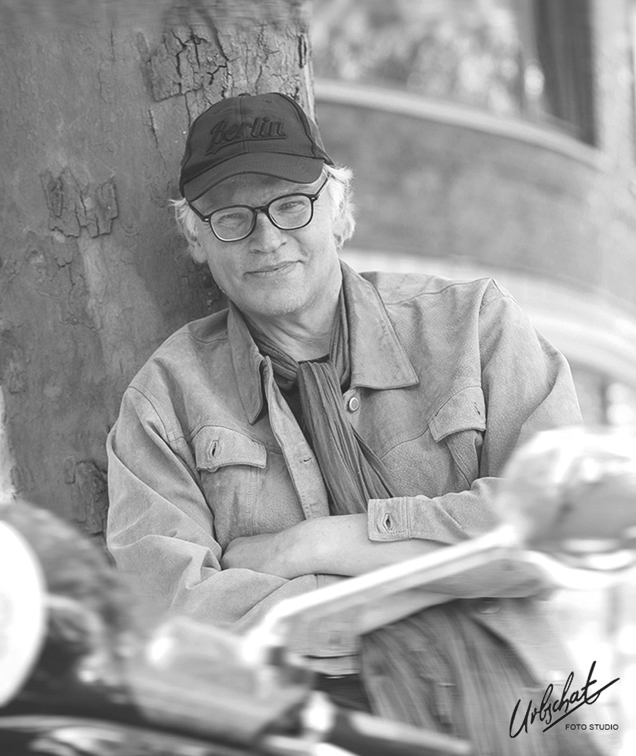
In Conversation with Johannes Reusch
✧・゚:⋆。°✩・:*。˚
What first drew you to photography and why did you choose to focus on black-and-white-imagery? And was there a specific moment when you realized photography would become your main artistic language?
Johannes:I have always been interested in designing, but designing with photography was added later. Photography -in its classical sense- isn’t absolutetly my artistic kind of expression, it’s only the basic of my work. The basic either for applied or for free, abstract, graphic works. These can be black-and-white-photographies, but it is not a must, can be colour-photography, too. Therefore my focus basically isn’t on black-and-white-photography, but in this exposition here in ‚Alte Münze‘ already it is.
Can you tell us a bit about your artistic journey?
J: As child I drew a lot, I’am still surprised about my productivity, when I see these quantities of drawings I’ve made during my childhood. Later -when being a teenager- I began to take pictures with a simple SLR Camera, developing the films by myself and printing in black and white, too. In these times I began to thinking first about studying design after school. Yes exactly, I am a graphic-designer, strictly: Dipl.-Kommunikationsdesigner/FH, I haven’t any education as a photographer, not in an entreprise, not at university, this fact is reflecting in my artistic work, too. Working as an artist I began around 12 years after my diploma, previously I’ve worked employed but selfsteady, too.
The title „Große Häfen-Rundfahrten“ evokes movement and tourism, what does it mean in the context of your work?
J: Naturally the title of the exposition evokes (thinking about) tourism, because this big billboard standing on Hamburg Landungsbrücken has – slightly modified – inspired me for the title of this exposition. In the exposition I show contrasts, which the visitors perhaps haven’t seen in such constellation not before, at example I am thinking about the modern Medienhafen in Düsseldorf on one hand and on the other hand this view of huge, more archaic Cairo.
What inspired you to focus on harbours as your subject?
J: In general it is not the focus of my artistic work to present harbours in my photography, I’ve developed the idea and concept for this exposition step by step. Seems to be an interesting theme, perhaps I’ll continuing working on it, made fun to deal with and hereby I mean the whole conception until finishing with the invitation-card, you know, I’ve worked with applied graphic subjects, too, and working with pictures and typography, combine them, is still interesting for me.
Do you plan your shots carefully, are they more spontaneous moments?
J: This is quite different, depending on location and opportunity. For the photographies which I’ve made in Cairo during a trip to there, I haven’t had the possibility for preparing anything. Because actually I’ve wanted to shoot something else there and before travelling to Cairo I’ve searched in Internet for some interesting locations, but these ideas I couldn’t realize finally being on site. However, for the photographies I’ve taken in Düsseldorf and in Hamburg, I could prepare better, both locations I could visit a few times, in Düsseldorf I lived nearly one year (but unfortunately not in Medienhafen ! ) and to Hamburg I’ve been travelling a few times from Berlin, where I am living now.
How do you decide when a photograph is „finished“?
J: This is a good, but difficult question, too, in particular when working with something more new and uncommon as abstract photography already it is. (I still have designed abstract art photography yet, but in this current exposition I don’t show any of chapter: ABSTRACTS). It’s difficult, because there’s the danger to work in a wrong direction, in the first moment you like something, but some days later – after seen it a second, third time – you don’t like it it anymore. It’s important to give and let yourself time, not to be content with a quick design-solution.
Your work seems to sit between documentary and artistic interpretation. How do you see it?
J:Yes, that’s true, „documentation“ is the title of a book-chapter I’am working on and therefore it is part of my artistic work.
What emotions or reflections do you hope viewers take away from this exhibition?
J: The term „viewing of contrasts“ I’ve mentioned already, simply reflecting about it… Perhaps I can inspire visitors to a little journey to Hamburg or Düsseldorf, these locations as Landungsbrücken and Medienhafen are worth to visit everytime, easy, quick and uncomplicated to reach, however moving in Cairo can be a (little) adventure sometimes, quite different to our habits here in Germany, in Europe.
Do you still shoot analog, digital, or a mix of both?
J: In every case: mixed, also because of that nearly every of mine images is post-processed. In the past I’ve worked with a lot of different cameras and film-formats, even with smartphone it is possible to shoot, to design interesting things, I think.
How much post processing is involved in your black and white images?
J: In general a lot, because shooting analog, developing, digitilazing, post-processing, printing fine-art-prints (in best case), presentation with mount and frames is a big effort (not in current exposition here in Alte Münze, for this I’ve taken only simple prints (because of the outdoor-presentation).
Do you have a personal connection to harbours or maritime culture?
J: No, there isn’t a personal connection, more or less I came by chance to the locations, they all are very interesting locations, I think, and perhaps there’s more „to get out of these“ (in sense of designing).
What are currently working on beyond this exhibition?
J: I’ll continue to work with a book, I’ve finished in the beginning of this year, to fill in further works, presenting it in a modified style. This will be a long working-process, and I’ll be occupied with it a long time more.
What advice you give to emerging photographers trying to find their voice?
J: How already said before, I am more a graphic-designer than a photographer, therefore perhaps I am not the right person to give advices to emerging photographers. But, whatever, there’s this important fact, in photography and in general in arts: it’s important to get an overview, visiting expositions, to find his place, perhaps there are any fields, not found before – o.k. this is a very difficult, but not an impossible thing
✧・゚:⋆。°✩・:*。˚